What Is Bid and Ask Price in Forex?

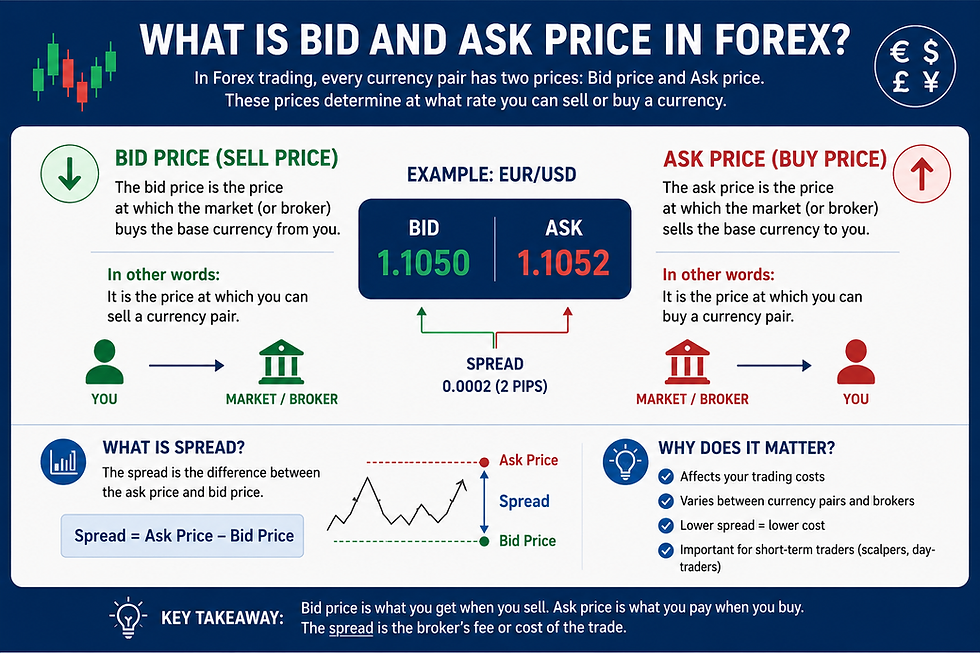
Whenever you look at a forex chart, you will notice two prices side by side.
Have you ever thought why there are always two prices, not one? What could they be called? So, the answer is that these two prices are called the bid price and the ask price. Together, they form one of the fundamental concepts in forex trading online. Every trade you place is directly affected by these.
Therefore, understanding the bid and ask in forex is important. So, in this blog, we will learn what these prices are, how they work, and their importance.
What is Bid Price in Forex?
In forex, a bid price is the price at which you sell a currency pair. Let’s understand this with an example. Imagine you want to sell your old mobile phone. You will go to a shop and ask the shopkeeper if you want to sell a phone at x price. The shopkeeper then offers you a price they are willing to pay. You either accept it or you do not.
The bid price works the same way. It is the price your broker is willing to pay you when you sell a currency pair. For example, if the bid price of EUR/USD is 1.1000, it means you can sell 1 Euro for 1.1000 US Dollars at that moment.
Remember, the bid price is always the lower of the two prices you see on your screen.
What is Ask Price in Forex?
The ask price in Forex is the price at which you buy a currency pair. Let’s take the same example. But this time you will go to a shop to buy a mobile phone. That is the price you have to pay if you want to buy it. The ask price works the same way. It is the price your broker charges you when you buy a currency pair.
For example, if the ask price of EUR/USD is 1.1003, it means you need to pay 1.1003 US Dollars to buy 1 Euro at that moment.
The ask price is always the higher of the two prices on your screen. You buy at the ask. You sell at the bid.
What is Spread?
The difference between a bid price and ask price is called the Spread. When you place a trade, you pay this difference. It is the cost of trading. Your broker earns from this spread when you open a position.
For example: The bid price of EUR/USD is 1.1000. And the ask price is 1.1003. The spread here is 3 pips. Those 3 pips are what your broker charges for executing your trade. That’s why you should always check the spread before placing a trade, as it directly affects your trading costs.
How are Bid and Ask Prices Determined?
You may have noticed that bid and ask prices never stay the same. They keep changing throughout the day. But what determines them? Let’s learn about the 2 key factors that play an important role:
Market Liquidity
Liquidity refers to how actively a currency pair is being traded at any given time. Usually, when a lot of buyers and sellers are active in the market, liquidity is high. As a result, this keeps the spread tight and prices more stable.
When less number of traders are trading, liquidity drops. The spread tends to widen during these periods. Therefore, prices become less predictable.
Market Volatility
Volatility refers to an increase in price movement. During high volatility, such as major economic news, bid and ask prices in Forex trading can shift quickly. The spread can widen during these movements.
For example, when a country releases its interest rate decision or employment data, the market can react instantly. It leads to a price jump and a widening of the spread. Here, conditions become unpredictable. As a result, being aware of these events can help you trade better.
How to Use Bid and Ask Price as a Beginner?
You now know what bid and ask prices are. But do you know how to use them to your advantage? Here are a few practical points to get you started.
Always check the spread before placing a trade: A wider spread means a higher cost. Knowing this can help you make better decisions.
Start with major currency pairs: EUR/USD and GBP/USD tend to have stable spreads. This can keep your trading costs lower as a beginner.
Be cautious around news events: Spreads can widen sharply during volatile periods. This increases your cost and makes price movements harder to predict.
Practise on a demo account: Watch how bid and ask prices move in real time. Get comfortable with them before trading with real money.
Factor the spread into your strategy: Always account for the spread when setting your profit targets and stop-loss levels. It is part of your trading cost.
Conclusion
The bid and ask prices in forex may seem like a small detail when you first start out. But they play a significant role in every trade you make.
The bid is what you sell at. The ask is what you buy. The difference between them is the spread, which is usually your trading cost. The more you understand these concepts, the more informed your trading decisions will become.
So, the next time you see two prices on your screen, you will not get confused anymore. You know what they are and how they work.

Comments